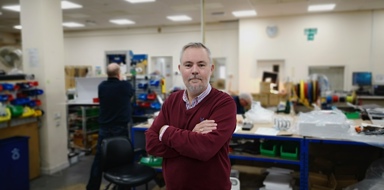



A manufacturer of specialist outdoor bags has tapped into digital talent to modernise its production processes with support from Made Smarter North West.
Innovative Outdoor Products, based in Nelson, Lancashire, designs and manufactures waterproof cases, cycling bags and outdoor accessories through a portfolio of brands including Aquapac, Carradice, Upso Bags and Swim Feral.
Through Made Smarter’s Digital Internship programme, the company partnered with Lancaster University engineering student Milanka Manathunga to convert more than 150 legacy cutting patterns into CNC-ready files. The project has improved production accuracy, reduced material waste and accelerated product development, while creating a foundation for future investment in advanced manufacturing technologies.
Innovative Outdoor ProductsBeing a small manufacturer in the UK means you’re competing globally all the time, so you have to look for every advantage. Made Smarter has been a really valuable ally. Support like this helps smaller businesses modernise and access technologies that larger companies already use.
Max Malavasi, Founder
The business traces its origins to 1983 when founder Max Malavasi came up with the idea for a waterproof bag that would allow him to listen to his Walkman while windsurfing.
That simple idea grew into a specialist manufacturing business exporting products to more than 60 countries worldwide.
However, much of its manufacturing heritage relied on traditional methods. Many cutting patterns used in production had been created decades earlier and existed only as physical templates made from cardboard or plastic.
While effective, these manual patterns made it harder to scale production, maintain consistency and integrate newer technologies such as CNC cutting.
Like many small manufacturers, the company also faces increasing pressures from global competition, changing trade conditions and rising costs, making efficiency and agility critical.
Seeking support to modernise its processes, the business connected with Made Smarter North West.
The journey began with a Digital Transformation Workshop, where skills and technology specialists visited the factory to understand how the business operates and identify opportunities to improve productivity.
The resulting digital roadmap highlighted several areas where technology could support efficiency gains, including modernising how the company manages its cutting patterns.
However, while the business recognised the need to digitise its large archive of legacy patterns, it did not have the in-house digital design capability needed to convert decades of physical templates into accurate CNC-ready files.
Through the Digital Internship programme, the company was able to bring in specialist digital skills to tackle this challenge. Milanka Manathunga, an engineering student with experience in CAD and digital modelling.
During the three-month placement, Milanka converted the physical templates into accurate digital files suitable for use with CNC cutting equipment.
Using CAD and vector design tools, he recreated the patterns and refined them through testing, correcting small inconsistencies that had developed through years of manual use.
The designs were then organised into a structured digital library grouped by product type and material, creating a centralised system that can be reused, modified and integrated into production workflows
The project has created the foundation for faster product development, improved production accuracy and greater flexibility when designing new products.
The new digital pattern library now underpins hundreds of items across the company’s product range, replacing ageing physical templates with precise digital files that can be reused and adapted.
As a result, the business expects to improve cutting accuracy by 15%, reduce material waste by 10%, and shorten production preparation times by two hours per product line, the equivalent of 15%.
Digitised patterns can also include markings and instructions that guide sewing teams during assembly, improving consistency across production runs.
Designers can now modify existing files to develop new products or refine existing ones, reducing development time from up to four weeks to less than a week.
For a manufacturer managing around 3,000 components across 500 finished products, even modest improvements in efficiency and material usage can deliver significant productivity gains.
The project also provided valuable collaboration between industry and academia.
Milanka Manathunga said: “This internship provided me with valuable industry experience and a clear understanding of how manufacturing operates in a real-world setting. Managing the project strengthened my problem-solving skills and allowed me to apply my academic knowledge to practical industrial challenges.”
The company is continuing its digital transformation journey and is currently implementing a new ERP system to improve planning, coordination and visibility across its operations.
It is also exploring further opportunities through the Made Smarter programme, including potential grants to support additional technology adoption.
For Max Malavasi, the key challenge is introducing change at a pace the organisation can manage.
“We’re dragging ourselves into the 21st century because we have to. If you don’t adapt and modernise, you risk becoming a dinosaur,” he said. “But there’s always a balance. You don’t want to go too slow, but if you try to change too much too quickly it can overwhelm your team. You have to prioritise and bring people with you.”